
Anyone who has ever felt a burning sensation near the chest, whether right after eating or lying down in bed, knows that it’s not a good place to be. After all, this is an indicator of heartburn, which happens when stomach acid flows back toward the esophagus in what is known as acid reflux.
In some cases, people interchange heartburn with another health issue that seems related: gastroesophageal reflux disease (GERD). It can be easy to see why, as heartburn is one common GERD symptom that appears because of acid reflux.
At this point, you may wonder: Is heartburn the same as GERD? Well, there are actually key differences between these two health issues you should know more about! Get some much-needed clarity on the heartburn vs. GERD saga with this guide.
What Is the Difference Between Heartburn and GERD?
While health experts note that there is some sort of overlap between heartburn and GERD, perhaps the most helpful way to understand these two health issues is to think of them as:
-
Heartburn: A symptom that you can resolve right away
-
GERD: A potentially chronic health issue characterized by heartburn showing up more than two times a week for a couple of weeks
Moreover, while both heartburn and GERD share similarities, such as that fiery feeling in your chest, throat, or even neck, why this happens can differ in people:
-
For heartburn: This can happen at night, while bending over, while lying down, or after consuming certain foods or drinks. Common causes and risk factors include being overweight, being pregnant, or consuming:
- Large and/or fatty meals
- Spicy, fatty, and/or fried food
- Tomato-based products
- Onions
- Citrus fruits like oranges and lemons
- Peppermint
- Chocolate
- Alcoholic beverages
- Carbonated beverages
- Coffee or other caffeinated beverages
-
For GERD: People with GERD may experience acid reflux more frequently because their lower esophageal sphincter (LES) does not function properly. The LES is located in the lower part of the esophagus. It’s tasked with preventing stomach acid from going back to the esophagus. The LES of someone with GERD may already be weak or relax when it should not, hence more instances of acid reflux. Some factors that can increase one’s GERD risk include:
- Smoking
- Eating fatty or fried foods
- Eating large meals
- Eating late-night meals
- Consuming alcoholic drinks or coffee
- Taking medicines like aspirin
Aside from heartburn, people with GERD may experience symptoms such as chest pain, regurgitation, swallowing difficulties, dry cough, or shortness of breath.
If there’s still some confusion with certain symptoms, you can consult a doctor or health professional who can help you understand and manage your condition better.
Are Treatments for Heartburn and GERD the Same?
It really depends on the symptoms someone is experiencing. For many years, health experts have noted that antacids are one of the best ways to address heartburn and GERD symptoms. Antacids are a class of medicines that help neutralize stomach acids and relieve heartburn symptoms.
People with GERD, however, may require something more potent or stronger, given that they may experience heartburn more often. This is where doctors may prescribe medicines like prescription-strength proton pump inhibitors, prescription-strength H2 blockers, or potassium-competitive acid blockers (P-CABs). In some cases, surgical procedures may even be advised.
What Medicine Should One Take for Heartburn or GERD Symptoms?
Although some circumstances make them different, symptoms of either heartburn or GERD can definitely cause discomfort and even interrupt someone’s daily routine. If you’re someone who constantly experiences heartburn or has already been diagnosed with GERD, count on any of the following to provide relief:
-
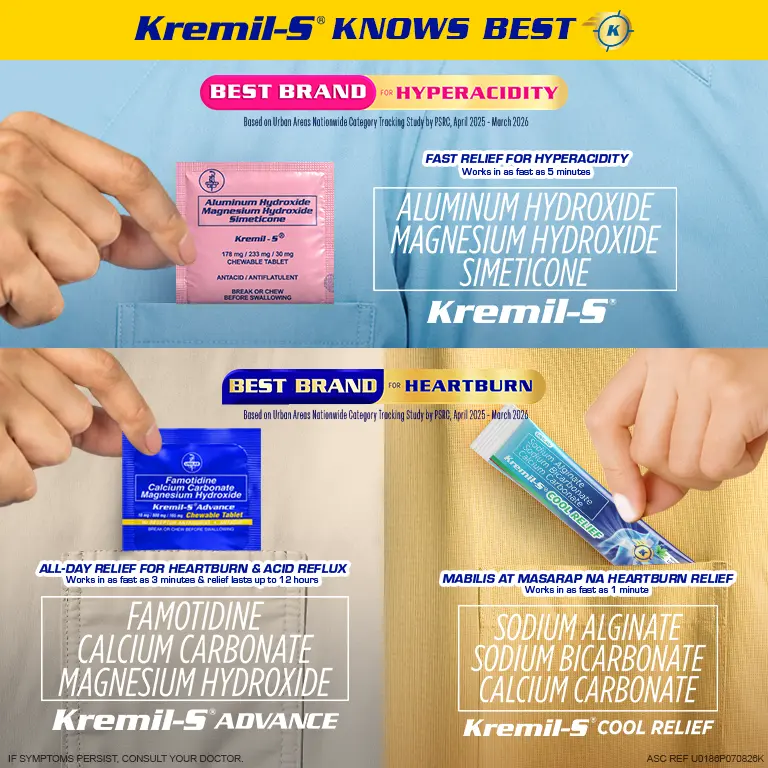
Famotidine Calcium Carbonate Magnesium Hydroxide (Kremil-S® Advance)
: This comes in a chewable tablet and contains antacids that help neutralize stomach acid and a histamine H2-receptor antagonist that helps reduce stomach acid production. As a result, this combination can help relieve heartburn in as fast as 3 minutes, with relief lasting up to 12 hours. -
Sodium Alginate Sodium Bicarbonate Calcium Carbonate (Kremil-S® Cool Relief)
: This peppermint-flavored solution can be used alongside GERD medicine to provide fast 1-minute relief from heartburn, acid reflux, and indigestion.Aside from antacids that assist in neutralizing stomach acids, this formula has a natural polysaccharide in sodium alginate. This substance creates a physical barrier to stop acid from going up the esophagus.
The next time you feel heartburn, don’t panic! Relieve your symptoms with the help of solutions from the Best Brand for Heartburn (Based on Urban Areas Nationwide Category Tracking Study by PSRC, Apr 2025-Mar 2026), whether in the form of chewable tablets like Famotidine + Calcium Carbonate + Magnesium Hydroxide (Kremil-S® Advance), or a liquid solution like Sodium Alginate + Sodium Bicarbonate + Calcium Carbonate (Kremil-S® Cool Relief).
Suggested use of Famotidine + Calcium Carbonate + Magnesium Hydroxide (Kremil-S® Advance) is one (1) tablet as needed for adults and children 12 years old and above, or as recommended by a doctor. Meanwhile, the suggested use of Sodium Alginate + Sodium Bicarbonate + Calcium Carbonate (Kremil-S® Cool Relief) is one (1) to two (2) sachets after meals and before bedtime up to four times a day or as recommended by a doctor.
If symptoms persist, consult your doctor.
ASC Ref. No. U0279P062326K, U0071P071526K
References:
https://www.ncbi.nlm.nih.gov/books/NBK557452/
https://my.clevelandclinic.org/health/diseases/9617-heartburn-overview
https://my.clevelandclinic.org/health/diseases/17019-acid-reflux-gerd
https://magazine.medlineplus.gov/article/acid-reflux-heartburn-and-gerd-whats-the-difference
https://www.mayoclinic.org/diseases-conditions/heartburn/symptoms-causes/syc-20373223
https://www.mayoclinic.org/diseases-conditions/heartburn/diagnosis-treatment/drc-20373229
https://www.mayoclinic.org/diseases-conditions/gerd/diagnosis-treatment/drc-20361959